If something took over your pasture and you can't name it, start here. These are the noxious species we deal with week in and week out on Douglas and Elbert county land — how to recognize each one, and what the state says you're obligated to do about it.
List B — spread must be haltedList C — counties follow state guidanceFree identification on site
Colorado List B
Leafy Spurge
Euphorbia esula
The hardest one on this page to get rid of, and the one most worth catching early.
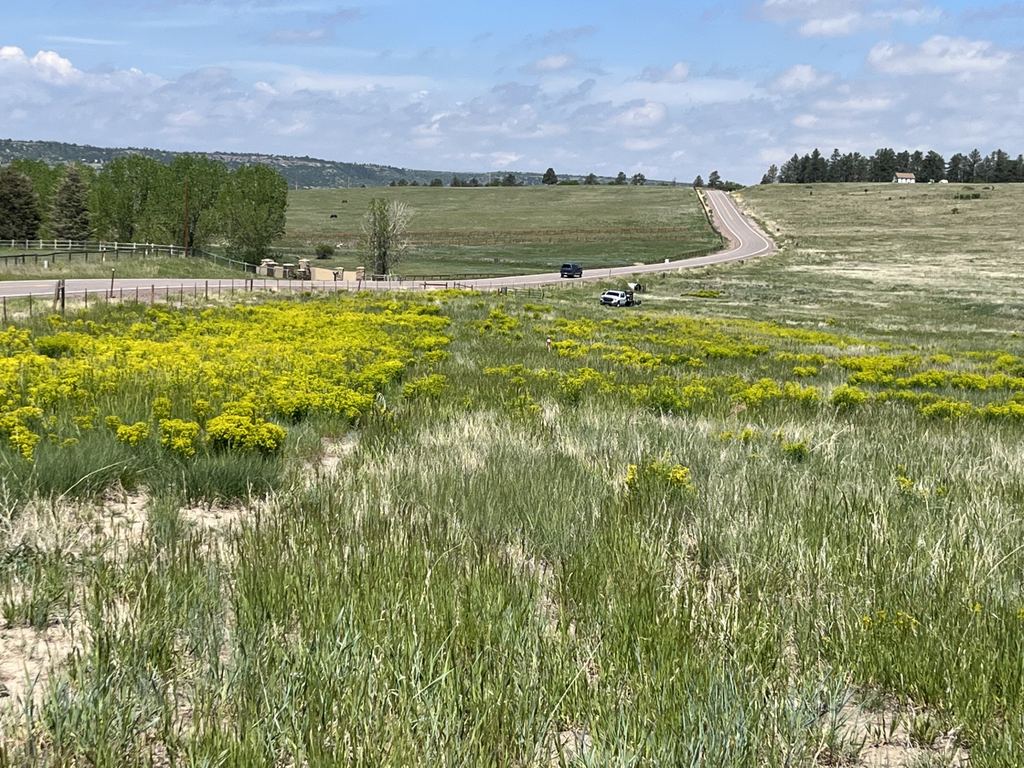
Leafy spurge in bloom on a Douglas County property.
Height
1–3 feet
Leaves
Narrow, 1–4 inches long
Flowers
Yellowish green, with a similar-colored bract beneath
Roots
Very deep tap root system with large nutrient reserves
Spreads by
Roots and seed. Seed capsules dry down and explode, projecting seed up to 15 feet
Watch out
Exudes a milky sap that can irritate skin — humans and livestock alike
Control
Very difficult. Expect multiple seasons of consistent management
Obligation
List B — the state requires that its continued spread be halted
Colorado List B
Canada Thistle
Cirsium arvense
The one most people mean when they say "I've got thistle." Tilling it makes it worse.
Canada thistle taking a field — this is what a colony looks like.
Height
1–4 feet
Flowers
Purple, ½–⅓ inch wide, multiple flowers per plant
Roots
Deep-rooted
Spreads by
Underground stems — forms colonies and spreads vigorously
Watch out
Tillage only increases numbers
Control
Aggressive and difficult to control
Obligation
List B — the state requires that its continued spread be halted
Colorado List B
Musk Thistle
Carduus nutans
Tall, spiny, and unmistakable once it flowers. It takes pasture in dense stands.
Musk thistle. The spines and the nodding purple head give it away.
Height
2–6 feet
Leaves
Large, deeply lobed and spiny
Flowers
Large purple flower, 1½–2½ inches wide
Spreads by
Seed
Watch out
Invades pasture and rangeland, forming dense stands
Control
Very competitive
Obligation
List B — the state requires that its continued spread be halted
Colorado List B
Dalmatian Toadflax
Linaria dalmatica
People often leave it because the flower is pretty. It's a deep-rooted perennial.
Dalmatian toadflax. Note the waxy leaves wrapping the stem.
Height
1–3 feet, perennial
Leaves
Waxy, wrapping around the stem — almost triangular or heart-shaped
Flowers
Yellow, snapdragon-like, with a long spur
Roots
Deep root system
Spreads by
Roots and seed
Control
Aggressive and difficult to control
Obligation
List B — the state requires that its continued spread be halted
Colorado List B
Yellow Toadflax
Linaria vulgaris
Also sold as an ornamental once upon a time. Commonly mistaken for a wildflower.
Yellow toadflax along a fence line — often mistaken for a wildflower.
Height
1–2 feet, perennial
Leaves
Numerous and narrow
Flowers
Yellow, about 1 inch long, snapdragon-like
Roots
Deep root system
Spreads by
Roots and seed
Control
Aggressive invader, difficult to control
Obligation
List B — the state requires that its continued spread be halted
Colorado List B
Diffuse Knapweed
Centaurea diffusa
Rough to the touch, and it outcompetes the forage you actually want.
Diffuse knapweed. Silvery, bushy, and rough to the touch.
Height
1–2 feet
Stems
Rough to touch
Leaves
Numerous and narrow
Flowers
White to purplish, flowering July–September
Spreads by
Seed
Control
Highly competitive
Obligation
List B — the state requires that its continued spread be halted
Colorado List C
Cheatgrass
Bromus tectorum
Also called downy brome. The fire risk is the real problem with this one.
Cheatgrass once it has dried down. This is the fire hazard.
Type
Winter annual
Leaves
Light green plant with soft hairs on the leaf
Germinates
Late summer into fall
Watch out
Mature plants dry out in the summer months, creating a fire hazard. Seed embeds in clothing and animal fur
Spreads by
Seed
Obligation
List C — control is left to local government, and Douglas and Elbert counties follow the state's guidelines and recommendations rather than requiring management
Colorado List C
Common Mullein
Verbascum thapsus
The fuzzy-leaved rosette everyone recognizes. The seed bank is what makes it persistent.
Common mullein. First-year rosettes and the fuzzy leaves.
Height
2–6 feet
Leaves
Large and fuzzy
Life cycle
Rosette in the first year, flowers in the second
Flowers
Yellow, on long stalks. Flowers and seeds June–August
Watch out
Stalks produce thousands of seeds that persist in the soil for years
Obligation
List C — control is left to local government, and Douglas and Elbert counties follow the state's guidelines and recommendations rather than requiring management
Still not sure what you're looking at?
That's the most common call we get, and there's no charge to find out. Tell us roughly where you are and what you're seeing, and we'll tell you what you're dealing with and what it will take to manage it.